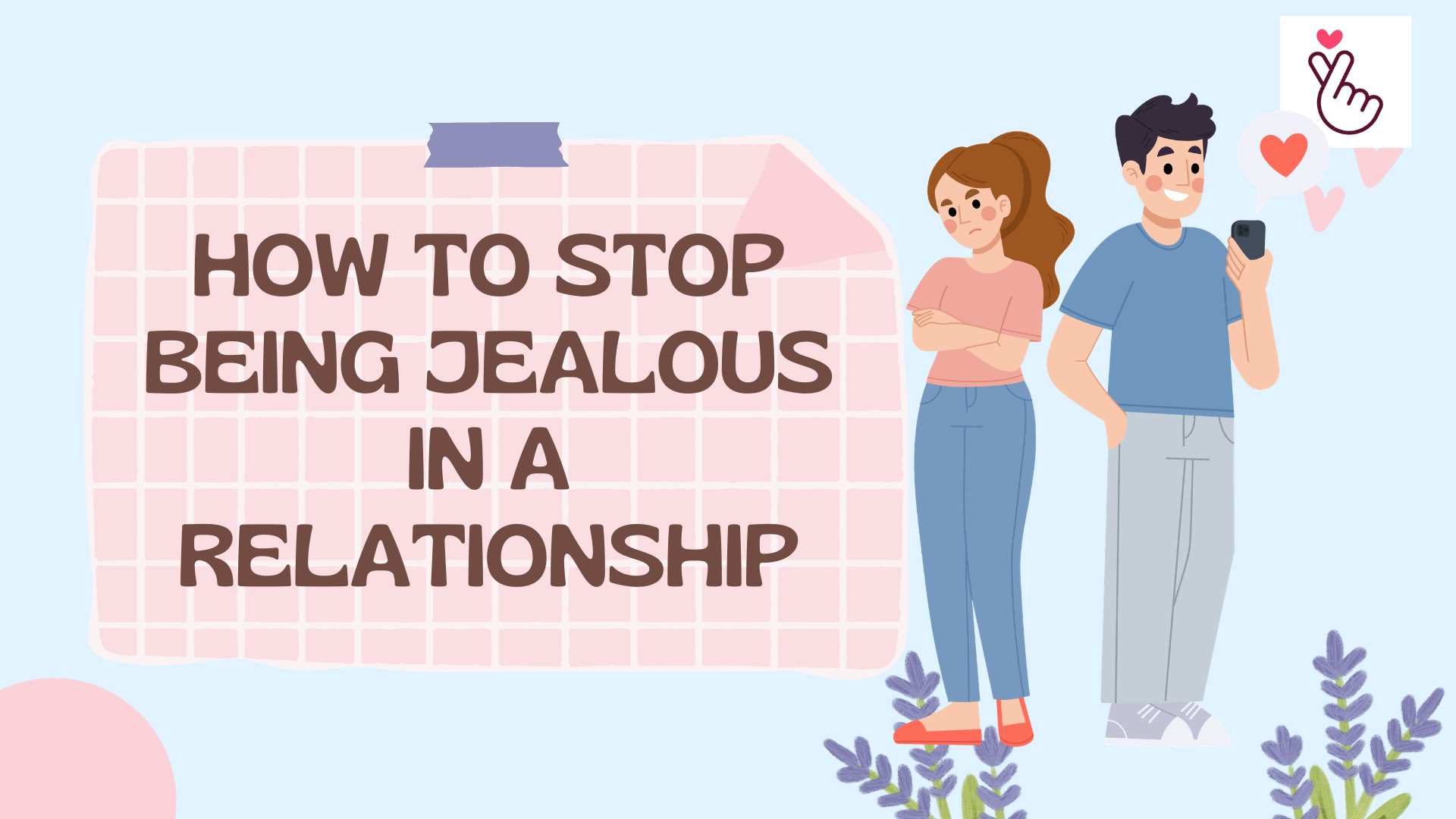
Learn how to stop being jealous in a relationship with practical tips to overcome insecurity, build trust, improve communication, and create a healthier, more secure relationship.
The five steps that consistently reduce relationship jealousy are: stopping the habit of monitoring your partner's digital activity, addressing the underlying self-worth issue rather than the external trigger, communicating your anxiety directly and vulnerably instead of reacting with accusations, stopping the comparison pattern by focusing on the specific choice your partner makes every day, and practising emotional tolerance so that uncomfortable feelings can pass without becoming actions. This guide covers all five with practical scripts and a daily checklist.
1. How to Stop Being Jealous: The Evolutionary Psychology Behind It
To stop feeling guilty about your jealousy, you first need to understand why it exists. From an evolutionary perspective, jealousy was a practical survival response. In early human groups, losing a partner meant losing resources, protection, and social position. When you feel jealous today, your Amygdala (the brain's threat-detection area) is activating a state very similar to physical danger, overriding the logical parts of your thinking.
The problem is that your brain cannot reliably distinguish between a real threat (your partner actually betraying you) and a perceived one (your partner laughing at a message from a friend). If you have an Anxious Attachment Style, your threat-detection system is especially sensitive, scanning constantly for any signal of potential abandonment.
2. The Critical Difference Between Jealousy and Intuition
One of the genuinely difficult parts of navigating jealousy is knowing whether you are being anxious without cause or whether your read of the situation is accurate. Here is how psychology separates the two:
| Trait | Anxiety-Based Jealousy | Genuine Intuition |
|---|---|---|
| The Trigger | Internal. Driven by hypothetical "what if" scenarios and comparisons to others. | External. Driven by observable, specific changes in your partner's actual behaviour. |
| The Sensation | Frantic, loud, obsessive, and emotionally overwhelming. | Quiet, persistent, calm, and difficult to dismiss. |
| The Evidence | Searching for proof of betrayal where none objectively exists. | Noticing clear inconsistencies: hidden phone behaviour, unexplained absences, shifting stories. |
If your partner is transparent, consistent, and communicative, but you still feel anxious regardless, the issue is internal. If their behaviour has changed specifically and they have become secretive, your read of the situation may be accurate and worth addressing. For guidance on distinguishing the two in practice, see our guide on relationship red flags.
3. Step 1: Break the Digital Monitoring Loop
In 2026, one of the fastest ways to damage your own mental health is to use technology to monitor your partner. As our guide on stopping relationship overthinking covers, checking their "Last Seen" status on WhatsApp, watching their Instagram activity, or tracking who they follow is a form of emotional self-harm. It does not produce information that helps. It produces data points your anxious brain then interprets in the worst possible way.
The practical fix: Set a deliberate digital boundary. Mute their activity status and stop checking their online behaviour. Actively searching for reasons to feel worried trains your brain to expect betrayal. Choosing to trust your partner means accepting some uncertainty rather than trying to monitor your way to reassurance.
4. Step 2: Address the Self-Worth Root
Jealousy is rarely about the third party. It is almost always about your own assessment of your self-worth. When you feel jealous of your partner's attractive colleague, your brain is not actually making a judgment about that person. It is running a fear: "I am not interesting enough, attractive enough, or valuable enough to keep this person's attention, so they will eventually choose someone else."
To address this, shift your focus from your partner's actions to your own sense of identity. Build something that is entirely yours and has nothing to do with the relationship: your career, your fitness, your friendships, your creative work. When your self-worth comes from your own consistent effort rather than from whether your partner stays, the fear of being replaced reduces significantly.
5. Step 3: Script the Vulnerable Conversation
When jealousy arrives, the common default is passive-aggressive behaviour such as the silent treatment, or controlling behaviour such as demanding your partner stop communicating with someone. Both approaches cause your partner to become defensive and produce the opposite of what you actually need. Instead, use Vulnerable Disclosure.
The wrong approach: "Why are you always texting Neha? You clearly like her more than me. Show me your phone."
The secure approach: "Hey, I know this is coming from my own insecurity rather than anything you have done, but when I see you texting Neha late at night my anxious brain starts telling me I am not enough for you. I do not want to control your friendships. I just need some reassurance right now."
A partner who genuinely cares will respond to the second approach with warmth and reassurance. That response, in turn, addresses the anxiety directly rather than escalating it.
6. Step 4: Stop the Comparison Pattern
Social media consistently presents curated, edited versions of other people's appearance and lives. This makes it very easy to compare yourself unfavourably to your partner's exes or their social circle. The practical counter to this is focusing on what is actually happening: your partner is with you. They have seen you in your worst moods, they know your habits, and they make an active choice every day to stay.
If you want to understand specifically what you bring to the relationship that meets your partner's emotional needs, take the Saranghae Love Language Test together. Understanding how you uniquely meet what they need reduces the fear of being replaced because it becomes concrete rather than abstract.
7. Step 5: Practise Emotional Tolerance
A significant part of overcoming jealousy is accepting that you cannot control another person's choices. If someone decides to betray the relationship, setting more rules or checking their phone more often will not prevent it. Attempting to control your partner pushes them away and creates exactly the boundary-less dynamic that makes relationships unstable.
Emotional Tolerance is the ability to sit with an uncomfortable feeling without immediately acting on it. When jealousy arrives, take ten slow breaths and tell yourself: "I am feeling anxious right now. That is a feeling, not a fact. I choose to trust my partner unless they give me a specific, factual reason not to." The feeling will reduce on its own if you do not act on it immediately.
The Jealousy De-Escalation Checklist
- Pause and breathe: Am I about to act from a sudden spike in anxiety, or from actual evidence?
- Fact vs. interpretation: Is there real evidence of something wrong, or is my brain constructing a story?
- Digital boundary: Have I stopped checking their social media activity and online status today?
- I-statements: Did I communicate my fear vulnerably and directly rather than as an accusation?
- Self-worth: Have I done something for my own personal growth or interests today?
- Acceptance: Have I accepted that I cannot and should not try to control their every interaction?
- Reassurance request: Did I simply ask for a hug or a clear word of reassurance rather than picking a fight?
- Light reset: Did I check our Love Calculator score just to add a moment of levity when the anxiety feels heavy?
Conclusion
Jealousy is tiring to carry. It keeps you focused on a threat that may not be real, which means you are not able to be genuinely present in the relationship you actually have. Reducing it is not about forcing yourself to feel nothing. It is about building enough internal stability and open communication that your nervous system does not need to treat every ambiguous signal as a crisis.
Start by taking the Free Saranghae Love Language Test together. Understanding your core emotional needs clearly, and sharing them with your partner, is one of the most direct steps toward genuine security. When your needs are known and met consistently, jealousy has far less to feed on.
Frequently Asked Questions
1. Is a little bit of jealousy healthy in a relationship?
A brief, passing reaction of protectiveness, such as noticing someone flirting with your partner and feeling a small response to it, is a normal human emotion. It can occasionally serve as a reminder not to take the relationship for granted. The issue arises when that feeling starts directing your behaviour, causing arguments, or making you controlling. At that point it has moved from a passing feeling into a pattern that needs addressing.
2. My partner intentionally tries to make me jealous. What does this mean?
This is a significant red flag and a recognisable tactic of emotional manipulation. Deliberately flirting with others in front of you or bringing up exes to monitor your reaction is a way of maintaining an anxious, uncertain dynamic. Secure partners work to create stability in the relationship rather than situations that undermine it.
3. How do I trust again if I was cheated on in a past relationship?
This pattern is known as projected trauma, where a past experience shapes how you read a new and unrelated situation. It is important to remind yourself daily that your current partner is not your previous one. They do not share the same values, choices, or history. Being transparent with your partner about what you are working through and seeking professional support are both highly recommended here. Telling your partner directly, "I am struggling today because of something from my past, not because of anything you have done," keeps the communication honest without placing unfair blame.
4. Should I ask my partner to stop talking to a friend who makes me uncomfortable?
You cannot dictate your partner's friendships. That is an ultimatum rather than a boundary. What you can do is communicate your discomfort honestly and without accusation: "I feel uneasy about how that person speaks to you sometimes." A partner who respects your comfort will naturally take that into account without you needing to make specific demands about the friendship.
5. Can the Love Calculator help with jealousy?
The Saranghae Love Calculator is a name-harmony tool for fun rather than a psychological resource. Using your high compatibility score as a light, playful moment when anxiety is high can occasionally shift the mood. The real work of reducing jealousy, however, comes from practising the five steps in this guide: open communication, self-worth building, and choosing to trust consistently.